
Amy Perez
Copy Editor
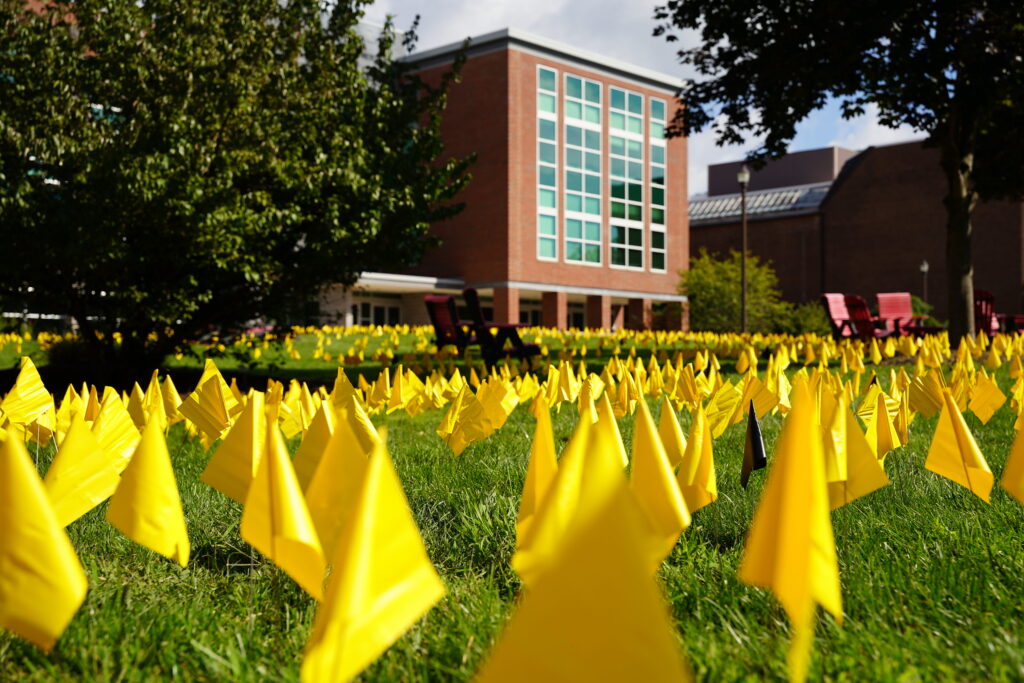
In the early hours of the morning on Sept. 10, you could walk or drive down Normal street and see students, faculty, and staff planting flags for World Suicide Prevention Day. Every year on Sept. 10, ESU’s Counseling and Psychological Services department (CAPS) takes the time to plant thousands of flags in representation of college students who have either succeeded in suicide or attempted annually in the United States.
Every year, that number grows higher.
Over 25,100 flags were planted on the lawns of Sci-tech and Stroud Henge in hopes to spread awareness and make an impact. Approximately 24,000 yellow flags represented the suicide attempts among college-age individuals in the United States each year, and 1,100 black flags were to represent deaths by suicide in that same population.
“Seeing the flags brought awareness and was impactful,” said ESU student Ciera Wilkerson, who provided feedback on her perspective after being a part of the flag planting team. Wilkerson said she didn’t realize the actual number of flags at first that were going to be planted for the event when she signed up to volunteer.
“I noticed the lawns getting filled, it made me realize what other people are going through in their classrooms or in their life and how a simple smile or respect can leave a positive impact on someone who may be struggling,” said Wilkerson.
World Suicide Prevention Day was established in 2003 by the in International Association for Suicide Prevention with a collaboration with the World Health Organization. It was created to remind people that suicide can be prevented and that the stigma about mental health could be reduced, along with spreading awareness.

“The goal for planting the flags was to make the numbers real for people,” said Dr. Jennifer Young, the Director for CAPS. “When you hear 24,000 or 1,100, it’s just a number. It’s hard to really picture what that means, but when you see thousands of flags covering the campus, you can’t help but stop and think about what those numbers represent. Each flag represents a person. I wanted students to stop and notice it, but I also wanted it to open the door to conversations. Suicide can be a really difficult topic to talk about, and sometimes just having something visible on campus gives people an opportunity to start that conversation.”
Young did her research and sought additional services through a grant to help support students who may be struggling. That service is an app that you download on your phone called TalkCampus.
“TalkCampus is an online peer-support community where students can connect with other students and talk about what they’re going through,” said Young. “Sometimes you don’t necessarily need to see a counselor—you might just need somebody to talk to who understands what you’re experiencing. Students can use it to share what’s going on, ask for support, or just read what other people are experiencing and realize, ‘I’m not the only one going through this.'”
“If you download the app you can also talk to people from other campuses,” said Isabel Warner, a student at ESU, when discussing TalkCampus. According to Warner, the app has been used as a safety measure when students are walking the campus at night.
“Sometimes my friend will go on it just so that it shows that she is talking to someone in case anything was to happen,” said Warner.
As the campus population grows each year and more students are away from home for the first time, the intakes at CAPS raise in numbers. More students are overwhelmed with the classwork, social aspects and keeping up with the demands of the college experience. Young finds that having TalkCampus readily available after hours and on weekends when the office is closed can come in handy to the students willing to download it.
“I think that’s really important for college students because they can feel very isolated, even when they’re surrounded by people. TalkCampus isn’t meant to replace professional counseling, especially if someone is in crisis, but it’s another resource that students can access when they need support,” said Young. “And it’s available at the time they’re experiencing something, rather than having to wait for an appointment.”
ESU has a decent-sized campus with many resources if you know where they are located. As the old saying goes, “it takes a village.” More than one resource on campus can help fill a student’s needs so that they can have a better shot at achieving their goals or succeeding academically and socially. Basic needs are important. According to Young, sometimes they need a village to help teach them with each part. No single person, department, resource or experience covers all of it.
“We have resources, but they don’t help anyone if students don’t know about them. That’s one of the reasons I think events like World Suicide Prevention Day are so important,” said Young.
Students, faculty and staff can help a student in need by submitting a CARE referral online.
“I think it’s really important for a college campus to recognize that students can be struggling in ways that we don’t see,” said Young. “A student can come to class, go to practice, hang out with their friends, and still be having a really difficult time. Suicide prevention also can’t just be the responsibility of CAPS or mental health professionals. It’s something that all of us have a role in.”