
Joylyn Wilson
Contributing Writer
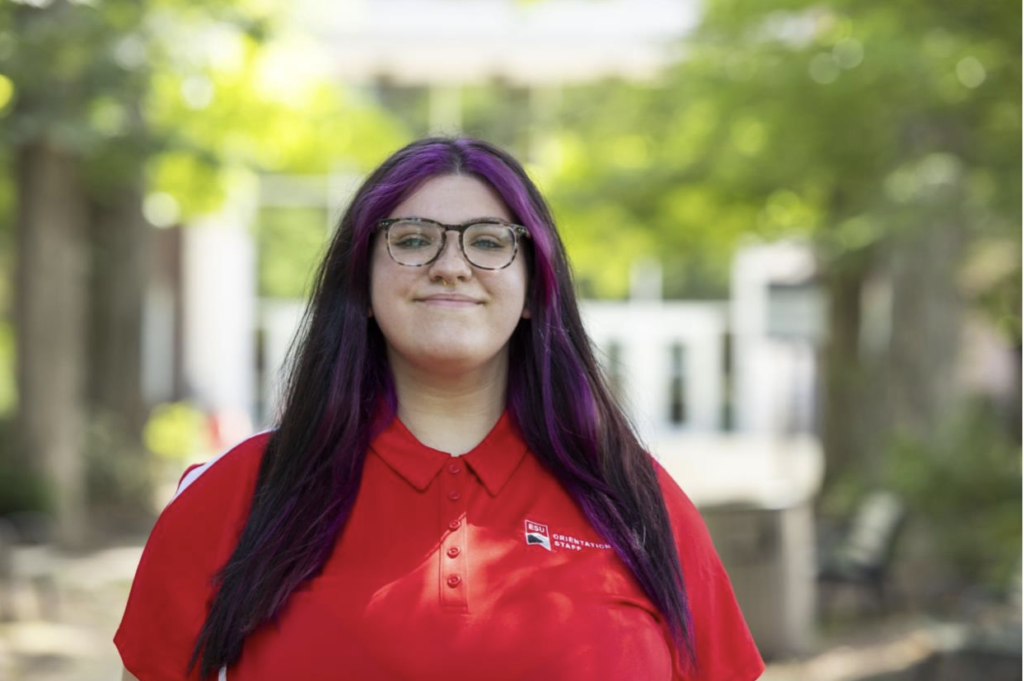
At 17 years old, Allexis Fuchs learned what it meant to move through the world without the certainty of a home. The experience of being homeless could have made her cruel at heart, with a cynicism for humanity, instead, it has made her softer — she is more empathic, more compassionate, and able to recognize the quiet struggles other people carry day to day.
Going through that experience now shapes Fuchs’ student life at East Stroudsburg University, where she has found something that previously felt out of reach. She found a safe haven.
It shapes the way she serves the campus community. She is a three year orientation leader and a first time resident assistant (RA) that helps other students connect with resources that allow them to feel less alone when they need support.
Fuchs is a worthy Stroud Courier candidate to write about because she has turned her setbacks into helping others. Her leadership style is less about authoritarianism and more about leading others with humility.
Fuchs chooses to listen without judgement and advocates for students whose concerns deserve to be taken with care. The result is a student learning how to lead and be a light to others while still making her own path.
She is balancing a demanding course of study — a speech, language, and hearing sciences major with a photography minor. As she manages campus responsibilities and employment, she draws from the time management and organization skills she has developed through years of completing her education.
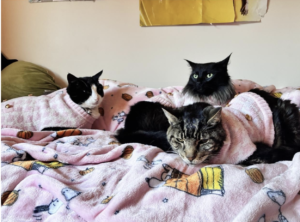
Her most important trait is persistence, as her cats, Patches and Bruce, share some of her traits. Fuchs’ empathy does not mean she is immune to social pressure. She has very strong social skills and is a good role model; a welcoming personality when I interviewed her. But I later learned that she has social anxiety. She is comfortable helping others connect, though she is also a homebody, who values quiet and familiar surroundings. That combination gives her a particular strength. Fuchs can make room for people without pretending that connection is always easy.
Fuchs’ educational journey started with great uncertainty. Around seventh grade, she started attending cyber school, a change that shaped the way she approached learning and eventually led to her graduation from Pleasant Valley High School. But high school itself was not guaranteed — she came close to not finishing.
Math was a major struggle, while English and English language arts were her strongest subjects. But she did not let math define what she could do. Her struggles simply became part of a longer lesson in learning how to work through frustration, seek ways forward and keep moving when confidence was difficult to find.
College offered a different kind of beginning. For Fuchs, arriving on campus felt like entering a place where safety and possibility could coexist. The transition did not erase the hardship she had experienced, but it gave her room to imagine a future beyond the hardships and to build relationships with people who could become part of her brand-new future.
Fuchs works and goes to school at the same time. Those demands have required planning, organization and careful attention to detail to time. Those skills now appear not only in her academic life, but also as she prepares for leadership responsibilities and responds to the needs of other students.
Her path through college has also changed direction. Fuchs initially studied education before moving into speech-language pathology, a field she finds challenging but enjoyable. The change reflects both an evolving sense of purpose and an interest in work that centers on communication, patience and helping people participate more fully in their lives.
On campus, Fuchs’ leadership has developed through service. As an orientation leader for three years, she has helped introduce new students to college life and to the relationships, expectations and resources that make a campus navigable. As a first-time resident assistant, she has taken on another layer of responsibility: supporting residents, helping them connect with the right resources and responding when they need assistance.
Those roles have strengthened her planning, organization and people-management skills. They have also required her to balance preparation with judgment. A schedule can be planned, but people do not always arrive with simple problems or clear solutions. Fuchs’ own experiences have helped her understand that support often begins with meeting someone where they are.
Her advocacy extends to accountability and safety. Fuchs supports victims of sexual assault and believes ESU should improve the way it responds to sexual assault. Her position comes from a concern for students who need to be heard and supported, not from a desire to sensationalize painful experiences. For her, advocacy means recognizing harm, taking concerns seriously and helping people find appropriate care and resources.
That type of work requires boundaries and discretion, especially in a residential setting. Fuchs’ role is not to solve every problem herself but to help students identify what they need, connect them with people equipped to help and remain present in a way that communicates respect. Her leadership has grown through that combination of responsibility and humility.
The same qualities appear in her everyday interactions. Fuchs can be welcoming and socially capable while still sometimes feeling crippling anxiety from the inside. She does not treat asking for help as a weakness. Instead, she has learned that reaching for support can be an act of trust — and that offering support carries the responsibility to handle another person’s experience with care.
Fuchs’ academic future is still taking shape. She is considering dropping her photography minor so she can graduate on time, a practical decision that reflects the competing priorities of college life. Photography remains meaningful to her, however, as one of the interests that gives her a creative outlet beyond school and service. Her personality is similarly made up of both public warmth and private comfort.

“You can still be professional and have a personality that never changes. That is possible and is something I’m going to train the new group of people that come in,” said Fuchs.
She loves cats (Bruce, Leo and Patches are their names), enjoys music and has an affinity for the color purple, characters like Loki, Snoopy, Roblox, TikTok and The Grinch. These details add texture to the person students may know primarily through an orientation program or a residence-hall interaction, but they do not overshadow the larger pattern of her life. She is drawn to things that offer comfort, imagination and connection.
After graduation, Fuchs may take some time off before deciding on her next step. She is considering earning a master’s degree to become a practicing speech-language pathologist, or pursuing an SLPA certificate. Both point toward work that would require the patience, communication skills and empathy she has been developing throughout college.
The difficult parts of Fuchs’ history remain part of her story, but they are not the whole story. Homelessness, family hardship, anxiety and the other challenges she has faced are not symbols to be displayed for effect. They are experiences that have informed the way she understands vulnerability and the way she chooses to treat people who are struggling.
She knows what it is like to need stability, direction and someone willing to respond with care. Now, while continuing to build life of her own meaning, she is learning how to offer those same things to others — one conversation, one connection, and one act of advocacy at a time.